
Recently, the Quantum Information Processing Research Team for Bound Systems at the Innovation Academy for Precision Measurement Science and Technology (APM), in collaboration with Sun Yat-sen University, Shenzhen University, and other institutions, has experimentally realized for the first time an entanglement-enhanced quantum phase-locking detection technology based on the trapped-ion quantum information experimental platform of APM. This achievement has successfully elevated the measurement precision to the limit allowed by quantum mechanics—the Heisenberg limit. The research findings were published in Nature Communications on December 6, 2025.
In the field of precision measurement, phase-locking amplification technology is extensively utilized to extract weak alternating current (AC) signals from noisy backgrounds. Traditional phase-locking detection aligns the frequency of the target signal with that of the reference signal through "frequency mixing", and then suppresses noise through "filtering", thereby extracting weak AC signals from a strong noise background. The quantum phase-locking detection technology developed in recent years utilizes the unique coherence characteristics of quantum systems. It achieves signal extraction and noise suppression through non-commutative quantum modulation and the time evolution of the system. This method has been experimentally verified in single-particle quantum systems.
However, it is difficult to break through the standard quantum limit by relying solely on quantum coherence. Theoretical studies have shown that using entangled states as detection carriers is expected to break through this limitation, elevating measurement accuracy from the standard quantum limit to the higher Heisenberg limit. The research team introduced quantum entanglement into the quantum phase-locking detection process for the first time and explored the potential of many-body entanglement in improving measurement accuracy. In the experiment, two trapped calcium ions were used. A maximally entangled state was prepared through high-precision control. By combining a periodic multi-pulse sequence as a quantum reference signal, phase-locking detection of the target alternating magnetic field was achieved. The experimental results indicate that when entangled states are used, the frequency measurement accuracy approaches the Heisenberg limit, which is significantly better than the standard quantum limit achieved when non-entangled states are used.
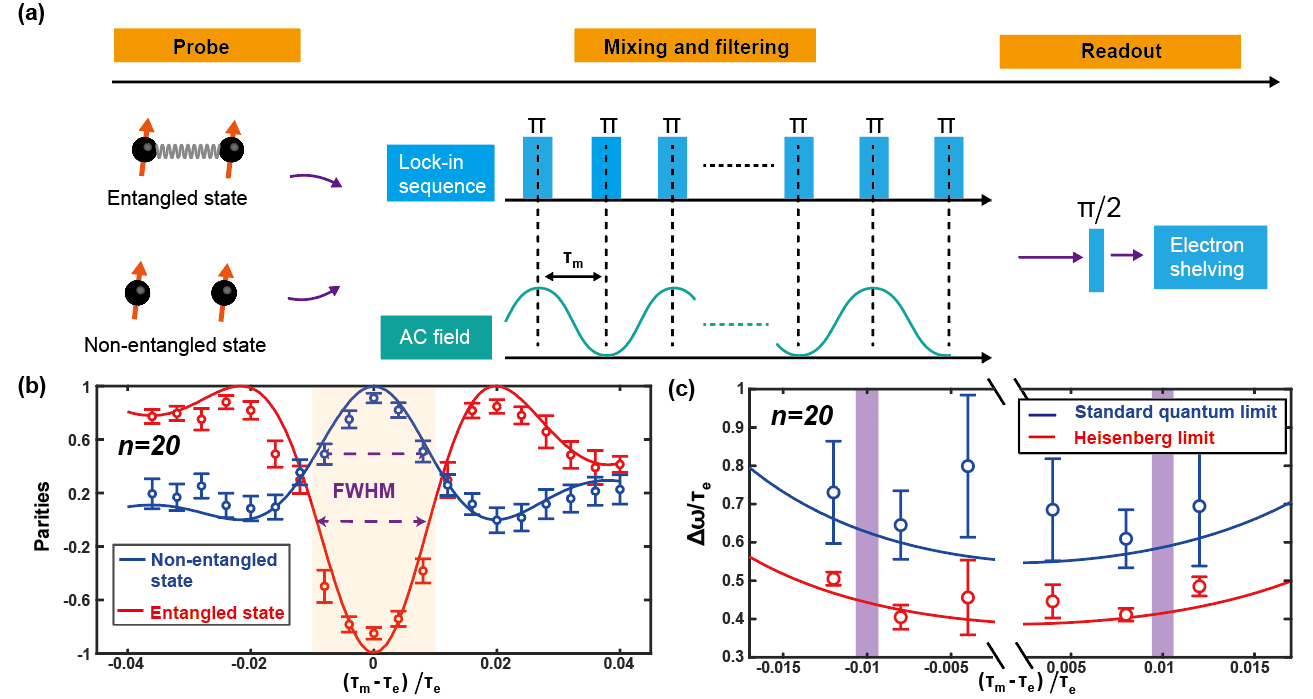
Schematic diagram of the principle of entanglement-enhanced quantum lock-in detection. (a) Experimental timing sequence from probe initialization to final detection; (b) Parity depending on the pulse period for entangled states (red) and non-entangled states (blue); (c) Comparison of measurement accuracy between entangled states (red) and non-entangled states (blue), showing that entangled states approach the Heisenberg limit.
It is noteworthy that this quantum phase-locking detection technology also demonstrates a unique "inverse-square time scaling" characteristic, that is, the measurement accuracy improves in inverse proportion to the square of the accumulation time, which has a distinct advantage over the linear improvement of traditional methods. To enhance the technical practicality, the research team further developed an optimized pulse sequence, which effectively suppressed common experimental interferences such as rotation angle errors and detuning errors, enabling the system to maintain a relatively high measurement accuracy under non - ideal experimental conditions.
This achievement has experimentally realized, for the first time internationally, the combination of entanglement-enhancement technology and quantum phase-locking measurement technology. It has achieved time-dependent signal measurement that breaks through the standard quantum limit, advanced the development of quantum entanglement-based precision measurement technology. Not only has it opened up new technological paths for the future development of high-precision quantum sensors and the development of new-type quantum detection devices, but it also holds great significance for promoting basic research in quantum information and quantum physics.
The study, titled "Entanglement-enhanced quantum lock-in detection achieving Heisenberg scaling", was published in Nature Communications. Ph.D. students WANG Bin and YUAN Wenfei from APM, Associate Professor ZHANG Jiawei from Sun Yat-sen University, and Assistant Professor ZHUANG Min from Shenzhen University are the co-first authors of the paper. Associate Researcher ZHOU Fei and Researcher FENG Mang from APM, and Professor LI Chaohong from Shenzhen University are the co-corresponding authors of the paper.
This research was funded by projects such as the Joint Fund Project and the Cultivation Project of the Major Research Plan of the National Natural Science Foundation of China.
Link to the article: https://www.nature.com/articles/s41467-025-66828-z