
Recently, the research team from the Innovation Academy for Precision Measurement Science and Technology (APM) has made new progress in the field of multimodal imaging. The research team constructed a hypoxia-responsive multimodal imaging system by fluorinating and modifying the photosensitive molecule aza-BODIPY and employing a fluorophilicity-driven co-assembly strategy in fluorinated oil. This system integrates fluorine-19 magnetic resonance imaging (¹⁹F MRI), near-infrared second-window fluorescence imaging (NIR-II FLI), and photoacoustic imaging (PAI), providing a new solution for precise imaging of deep-seated tumors. The findings were recently published in Advanced Science.
To address key issues commonly existing in deep-seated tumor imaging, such as limited signal penetration, strong background interference, and difficulty in accurate quantification, the research team designed a multifunctional fluorinated aza-BODIPY (OFBD) for precise imaging and treatment. The N-oxide group was introduced to provide hypoxia-responsive functionality, while perfluoro-tert-butyl groups containing nine equivalent fluorine atoms ensured a single and quantifiable ¹⁹F MRI signal, avoiding multi-peak signals and chemical shift artifacts commonly seen in perfluorinated systems. In the fluorinated oil, OFBD molecules undergo fluorophilicity-driven co-assembly into ordered J-aggregates. This arrangement not only shifts fluorescence emission into the NIR-II region (up to 1200 nm), enhancing the tissue-penetration ability of FLI, but also ensures that all fluorine atoms are in equivalent chemical environments, achieving a uniform ¹⁹F MRI signal and 100% utilization of fluorine atoms. In addition, OFBD activates a hypoxia-responsive photoacoustic signal at 870 nm, enabling precise imaging of oxygen-deficient tumors.
As a photosensitive molecule, OFBD exhibits a transition from photodynamic to photothermal effects under hypoxic conditions, effectively alleviating the reduced efficacy of traditional photodynamic therapy in hypoxic tumors. Guided by multimodal imaging and applying laser irradiation when the probe reaches its maximum accumulation at the tumor site, efficient tumor ablation can be achieved.
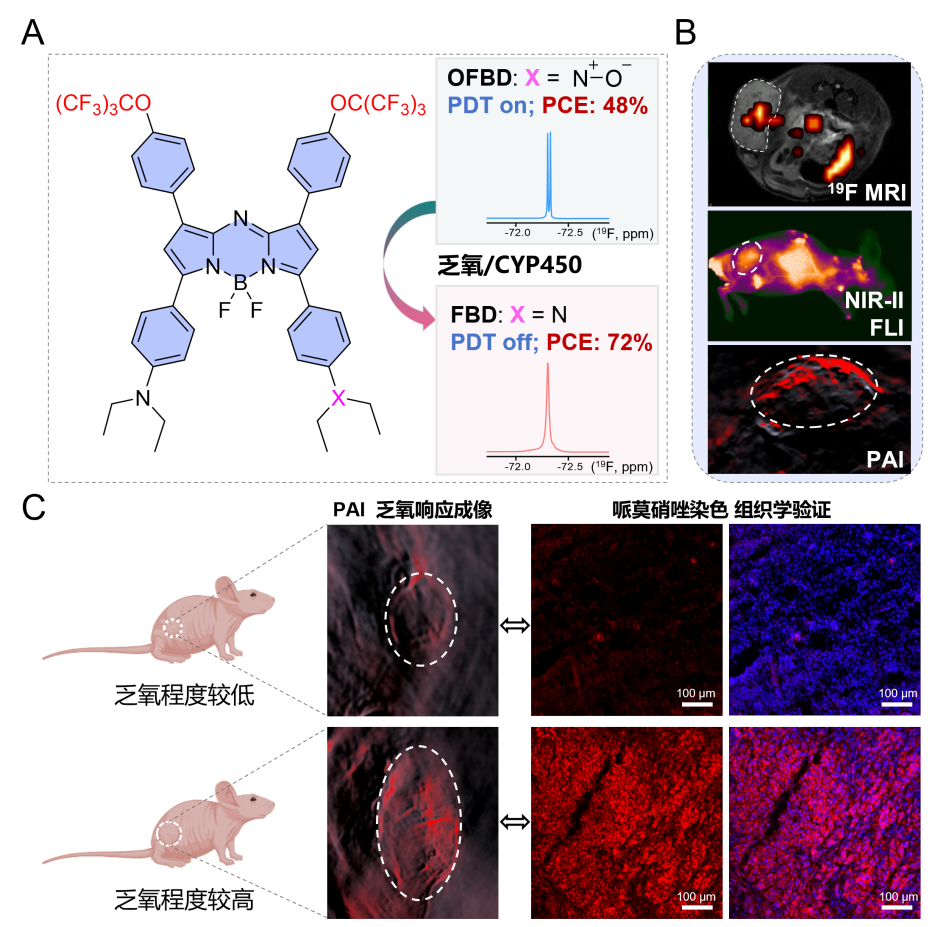
(A) Molecular structures and 19F NMR spectra of OFBD and its reduced form FBD; (B) Multimodal imaging of OFBD nanoemulsions in mice, including ¹⁹F MRI/NIR-II FLI/PAI; (C) Assessment of tumor hypoxia by PAI and pimonidazole staining
This study, focusing on functional molecule design and aggregation state regulation, provides a new paradigm for precise imaging and visualized treatment of deep-seated tumors. The findings were published in Advanced Science under the title "Fluorinated Hypoxia-Responsive Aza-BODIPY for NIR-II FL/¹⁹F MR/PA Imaging and Phototherapy of Lung Cancer". For the relevant research achievements, Ph.D. candidate LI Anfeng, postdoctoral researcher WANG Fang, and Ph.D. candidate JIANG Mou from APM are the co-first authors, while Associate Researcher LI Yu, Researcher ZHOU Xin, and JIANG Zhongxing are the co-corresponding authors.
This research work was supported by the Strategic Priority Research Program of the Chinese Academy of Sciences and the National Natural Science Foundation of China.
Link to the article: https://advanced.onlinelibrary.wiley.com/doi/10.1002/advs.202521886