
Recently, the research team led by HUANG Xueren from the Innovation Academy for Precision Measurement Science and Technology (APM) has made important progress in the research of transportable optical clocks and their timekeeping applications. The team has developed a compact and transportable optical clock based on the calcium-ion, and jointly carried out research with the Beijing Satellite Navigation Center on the application of optical clock steering hydrogen maser in timekeeping. This achievement has improved the monthly frequency instability of hydrogen maser by two orders of magnitude, fully demonstrating the superiority of optical clock as a high-precision frequency reference in independent and self-reliant timekeeping applications. Relevant research results have recently been published in Metrologia, a renowned journal in the field of metrology sponsored by the Bureau International des Poids et Mesures (BIPM).
In recent years, the frequency shift uncertainty and stability of optical clock systems have reached the order of E-18 to E-19, making them expected to replace cesium fountain clocks and become the realization method for the next-generation definition of the International Second (SI). High-precision optical clocks boast broad application prospects in fields such as fundamental physical law verification, metrology and geodesy. Taking metrology as an example, International Atomic Time (TAI), a time scale with an accuracy at the order of E-16, has become the traceability reference for national time metrology institutions. It is obtained by weighted averaging of about 500 microwave atomic clocks worldwide, among which about 90% of the contribution comes from active hydrogen masers. Active hydrogen masers feature excellent reliability and daily stability, but their working mechanism determines that they have an unavoidable long-term frequency drift, which leads to a significant deterioration in long-term stability. Therefore, how to suppress this frequency drift and make the hydrogen masers "both accurate and stable" has become one of the important tasks and core challenges in the field of time metrology for many years. Using high-precision optical clocks to steer microwave clocks such as hydrogen masers for timekeeping is recognized by the international time-frequency community as the core technology of the next-generation timekeeping system. The high-precision "optical time scale" realized in this way is expected to solve the above problems and achieve an intergenerational improvement of the timekeeping system. However, due to practical problems such as the extremely high complexity of optical clock systems, international research in the optical clock field is generally still in the stage of basic laboratory research and principle demonstration, making it difficult to provide high-precision and high-reliability optical clocks for long-term timekeeping services.
In response to the above problems, the Ion Optical Frequency Standard Team of APM has long been engaged in the development of compact and transportable optical clocks to meet the major needs of the country's high-precision time-frequency system construction. The team publicly reported the world's first prototype of a transportable optical clock based on a single ion in 2017, which drew widespread attention and high praise from international peers. After years of research, the team has systematically proposed a complete set of modular and integrated solutions for transportable optical clocks, realized the localization of a series of core components, and achieved multiple technological innovations in the in-depth suppression of optical clock frequency shift physical effects and precision measurement, obtaining more than ten national invention patents. In 2023, the team developed a new generation of compact and integrated transportable optical clock, whose system frequency shift uncertainty reaches 1E-17 and daily stability reaches 3E-17. This achievement was selected into the "Self-developed Scientific Instruments of the Chinese Academy of Sciences" catalogue, laying a solid foundation for the wide application of transportable optical clocks.
In the research of this project, the transportable optical clock arrived at the destination after 1200 kilometers of express delivery, and completed the installation and commissioning successfully and started operation smoothly within one day. In the subsequent six-month research on optical-clock-steered hydrogen maser timekeeping, benefiting from the high-precision specifications of this optical clock and its ultra-high operation rate of 93.6% per half year, the team members realized the accurate construction of the noise model for the active hydrogen maser, and thus optimized the design of the steering strategy and steering algorithm, finally achieving the precise elimination of the frequency drift of the active hydrogen maser. The research results show that the monthly frequency stability of the hydrogen maser after being steered by the optical clock has been improved from 3E-15 to 4E-17, with an enhancement of up to two orders of magnitude. This means that the accuracy of the resulting optical time scale is expected to reach an extremely high level of 100 picoseconds per month. Meanwhile, the researchers also evaluated the optical time scale generated by the steering process with Coordinated Universal Time (UTC, which is TAI plus leap second correction) as the reference. The results show that its monthly stability has reached the 1E-16 limit level of UTC itself, which is significantly better than the time scales produced by many international timekeeping institutions that use cesium fountain clocks to steer hydrogen masers for timekeeping in the same period.
This compact transportable optical clock features excellent reliability, and the optical time scale generated by the steering process delivers outstanding performance, which is of great significance for promoting the extensive practical application of high-precision optical time scales. The reviewers spoke highly of the study, commenting that "The transportable optical clock has impressive uptime and the demonstrated stability of the optically-steered timescale shows a significant improvement. The experimental work shows encouraging results in terms of future optically-steered timescales."
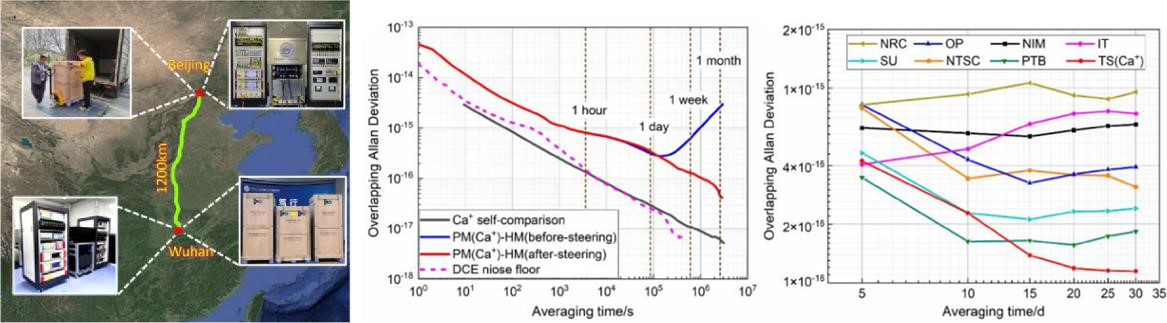
The transportable optical clock and the performance of optical time scale generated by its steering of hydrogen masers
The research achievement was recently published in Metrologia, a renowned journal in the field of international metrology, under the title "Local time scale upgrade with a transportable optical clock". YUAN Yi and YUAN Jinbo, postdoctoral researchers from APM, and senior engineer CAO Jian are co-first authors. Senior engineer CAO Jian, researcher HUANG Xueren from APM, and senior engineer LI Guojun from the Beijing Satellite Navigation Center are co-corresponding authors. This research work also received strong support from the research team of CHEN Qunfeng at the Frequency Standard Technology Center of APM.
The research on compact and transportable optical clocks has received long-term strong support from institutions including the Ministry of Science and Technology, the National Natural Science Foundation of China, and the Chinese Academy of Sciences.
Link to the article: https://iopscience.iop.org/article/10.1088/1681-7575/ae46a4