
Recently, the Biomedical Metabolomics Team of the Innovation Academy for Precision Measurement Science and Technology (APM) has made important progress in the research on the function of small-molecule metabolites to delay aging and improve age-related chronic diseases. Using multi-omics technologies such as microbiomics and metabolomics, combined with bioinformatics, the team systematically analyzed the microbiome and metabolome characteristics of fecal samples from populations of different age groups (young, elderly and centenarian), identified key gut bacterial strains and metabolic markers during the aging process and performed functional validation, providing a new strategy for delaying aging and improving age-related chronic diseases. The relevant research results have been published in iMeta.
Imbalance of gut microbiota and host metabolic disorders are two major factors driving the aging process. The diversity, composition and function of the human gut microbiota change significantly with aging, and maintaining a relatively "young" microbial community has been proven to alleviate age-related decline. Therefore, identifying the biological signatures of gut microbiota imbalance and host metabolic disorders during the aging process is of great significance for understanding human longevity and guiding precise geriatric medical interventions for age-related diseases.
The research team collaborated with multiple institutions including Hubei Provincial Hospital of Traditional Chinese Medicine (Affiliated Hospital of Hubei University of Chinese Medicine), Southern Medical University and Guangxi Alage Life Science Corporation Ltd. After more than two years, they collected fecal samples from populations of different age groups (young, elderly and centenarian) (Ethics No. for population cohort study: AS‐LL‐ZD‐001). Using multi-omics technologies combined with bioinformatics, they conducted a detailed analysis of the microbiota and metabolic characteristics during aging, constructed an aging microbiota and metabolism database, and identified the key gut microbial strain Clostridium scindens in centenarians and its characteristic metabolite indole-3-acetic acid (IAA). They further used cell models, naturally aging mouse models and gene knockout mouse models (Ethics No. for experimental animal study: APM24005A) to deeply elucidate the anti-aging mechanism, in which IAA mediates the expression of intestinal tight junction protein (CLDN10) through the aryl hydrocarbon receptor (AHR), thereby regulating intestinal homeostasis (as shown in the figure below). In addition, the team found that IAA supplementation can ameliorate osteoporosis in an AHR-dependent manner. Oral administration of IAA can also activate the interaction between intestinal AHR and poly (ADP-ribose) polymerase 1 (PARP1), repair DNA damage during the aging process and delay cellular senescence. This series of studies demonstrates that the endogenous small molecule IAA has application prospects in anti-aging and improving age-related chronic diseases.
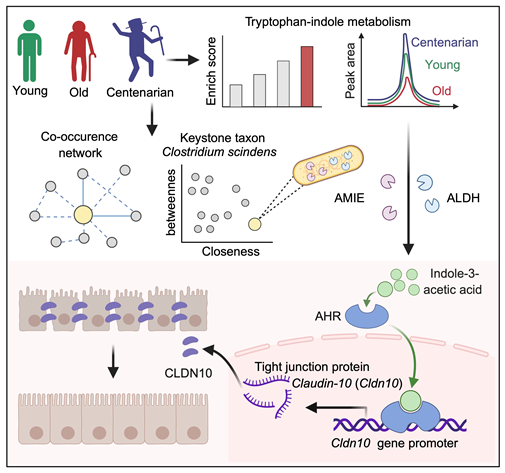
C. scindens and its metabolites regulate intestinal homeostasis via activating the AHR-CLDN10 signaling pathway through IAA
The relevant research results were published in iMeta under the title "Microbial keystone taxa and metabolic signatures in centenarians regulate intestinal homeostasis during aging". LIN Weichuan, special research assistant at APM, PhD candidate ZHANG Cui, and associate researcher LEI Hehua are the co-first authors of the paper. Researcher ZHANG Limin from APM, Professor CHEN Gang from Hubei University of Chinese Medicine, Professor XIE Denghui from Southern Medical University, and Dr. LUO Weifei from Guangxi Alage Life Science Corporation Ltd. are the co-corresponding authors.
This research work was funded by projects including the Chinese Academy of Sciences and the Hubei Provincial Department of Science and Technology.
Link to the article: https://doi.org/10.1002/imt2.70134