
The Image Geodesy Research Group of the Innovation Academy for Precision Measurement Science and Technology (APM) utilized Ground Penetrating Radar (GPR) to conduct ice thickness observation experiments on the Bayi Glacier and the 23k Glacier on the Qinghai-Tibet Plateau. Addressing the severe interference from water-rich ice layers encountered in GPR-based ice thickness measurements, the group proposed a novel radar detection method for subglacial terrain beneath water-rich glaciers. This method effectively extracted the undulating characteristics of the ice-rock interface within water-rich glaciers and significantly enhanced the capability for fine-scale detection of subglacial terrain in scenarios with high water content media. Recently, the relevant research findings have been published in the IEEE Transactions on Geoscience and Remote Sensing.
Subglacial terrain serves as a core parameter in the dynamic simulation of mountain glaciers, holding significant importance for research on glacier mass balance, as well as the processes and mechanisms of glacier-related disaster formation. Under the influence of the climate's "warming and moistening" trend, the water-bearing media within mountain glaciers in China have generally increased. Due to the prominent nonlinear dispersion characteristics of electromagnetic waves in water-rich glacier media, the use of Ground Penetrating Radar (GPR) for measuring glacier thickness is confronted with the "measurement inaccuracy" challenge.
For this purpose, the research team collected data from 12 Ground Penetrating Radar (GPR) ice-thickness survey lines during field expeditions at the Bayi Glacier and the 23k Glacier in March 2023 and September 2023 respectively. Based on this data, they constructed a perspective radar beam distortion model and an ice-rock interface detection model for water-rich glacier scenarios. They also analyzed the error propagation characteristics of glacier thickness measurement, proposed a joint particle swarm optimization-conditional trimmed mean-constant false alarm rate detection (PSO-CTM-CFAR) technique for extracting the undulating features of the ice-rock interface, and achieved refined detection of sub-glacial terrain under low signal-to-noise ratio conditions.

The locations of Bayi Glacier and 23K Glacier and the GPR measurement routes
The research results indicate that, compared with traditional image enhancement methods and other classical CFAR methods, PSO-CTM-CFAR method reduces the measurement error of water-rich glacier thickness by approximately 30%; under low signal-to-noise ratio conditions, it reduces the measurement error by about 50%. In addition, this study has, for the first time, obtained absolute thickness data for some areas of the 23k Glacier, and addressed the challenge that traditional ground-penetrating radar (GPR) technology has difficulty in detecting the ice-rock interface of water-rich glaciers.
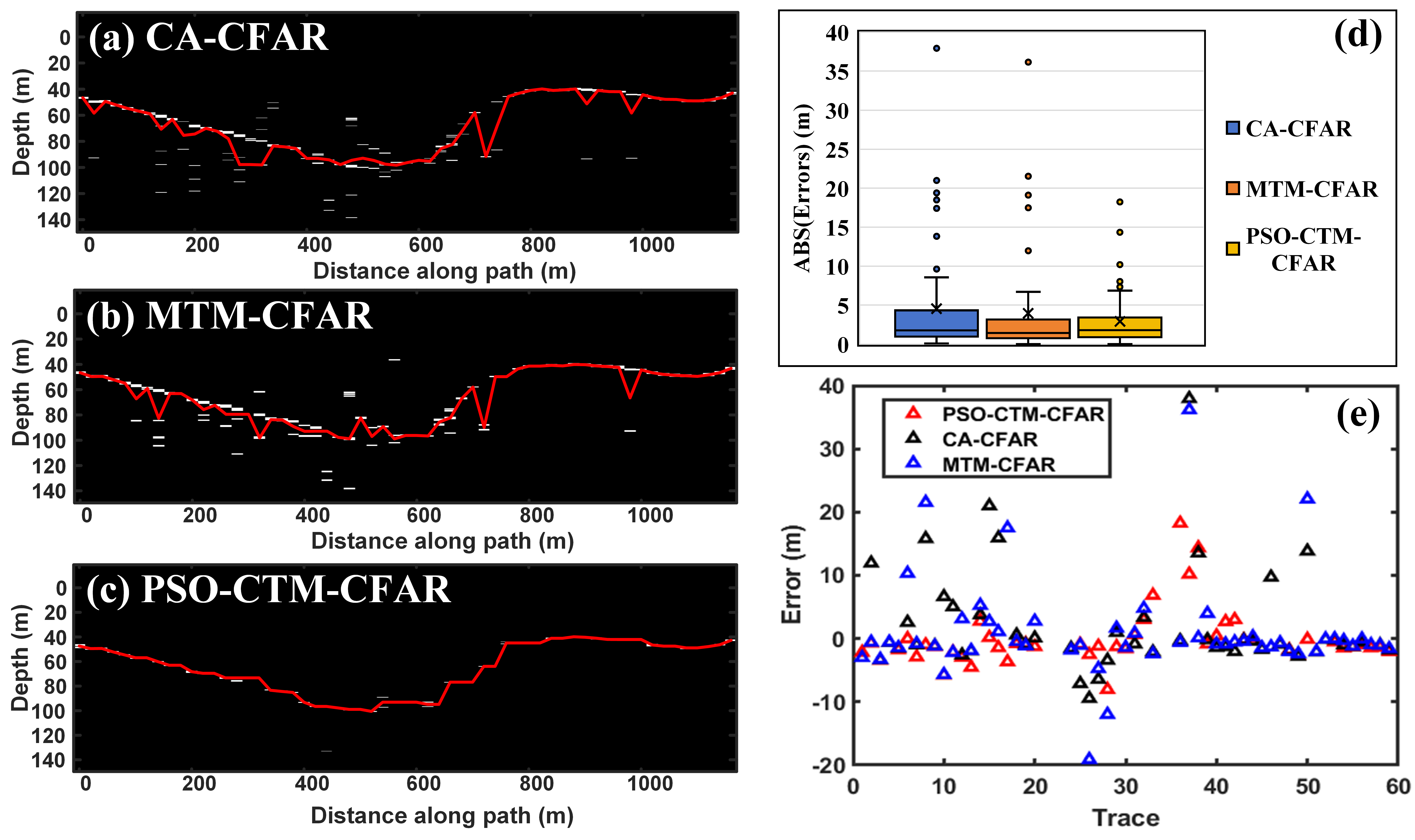
(a)-(c) Undulating characteristics of the ice-rock interface along the 04 survey line of Bayi Glacier; (d)-(e) Comparison of measurement errors of three CFAR-based methods
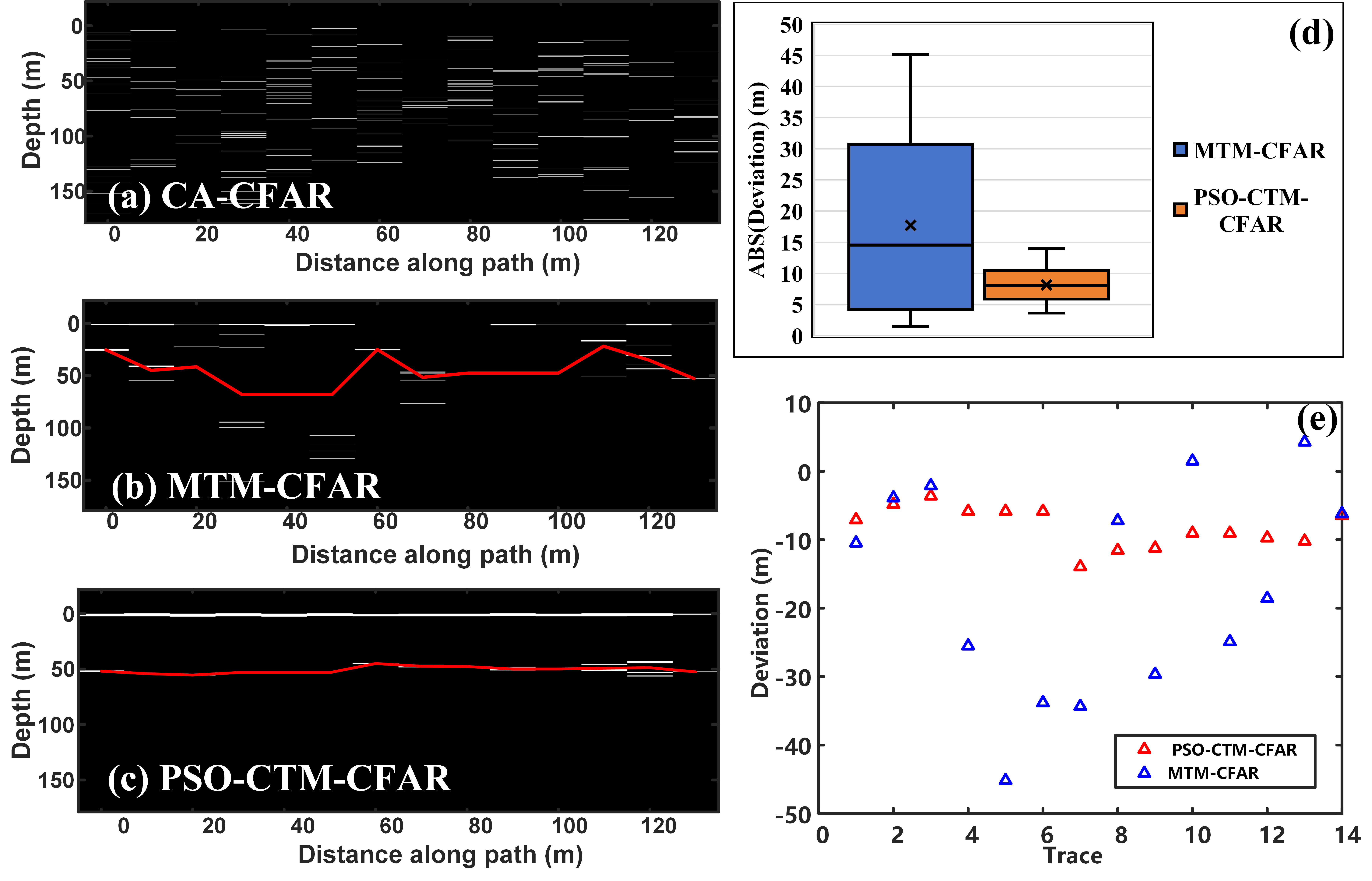
(a)-(c) Undulating characteristics of the ice-rock interface along the 47 survey line of 23K Glacier; (d)-(e) Comparison of measurement errors among three CFAR-based methods
In recent years, sudden ice avalanche disasters have occurred frequently in the Qinghai-Tibet Plateau region, posing a severe threat to the lives and property of local people. The new radar detection method for subglacial topography of water-rich glaciers proposed in this study can provide important technical support for the accurate inversion of ice thickness and the risk assessment of glacier disasters in high-water-content medium scenarios.
The relevant research results were published in IEEE Transactions on Geoscience and Remote Sensing under the title "Thickness Measurement for Mountain Glaciers with Water-Rich Ice Based on VHF GPR and PSO-CTM-CFAR Detector". APM served as the first completing institution. Postdoctoral researcher WU Yuxuan was the first author of the paper, and researcher JIANG Liming was the corresponding author.
This research was jointly funded by the National Natural Science Foundation of China (No.42174046), the Key Program Project of the Natural Science Foundation of Hubei Province (No.2021CFA028), and the Youth Class B Project of the Natural Science Foundation Plan of Hubei Province (No.2025AFB417).
Link to the article: https://ieeexplore.ieee.org/document/11142849