
Recently, the trapped-ion physics research team at the Innovation Academy for Precision Measurement Science and Technology (APM) has made a major breakthrough in optical-clock research. The total system uncertainty of the second-generation liquid-nitrogen cryogenic calcium-ion optical clock developed by the team has reached 4.4E-19, corresponding to an error of no more than 1 second in about 72 billion years of continuous operation.This represents the best reported uncertainty performance among optical clocks to date, and the results have been published in Physical Review Letters.
Optical clocks utilize the stable energy-level transitions of atoms or ions as frequency references and are currently the most accurate timekeeping devices available. Its systematic uncertainty directly determines the accuracy and reliability of the future time. Reducing system uncertainty to the E-19 level will not only help meet the requirements for a next-generation definition of the second, but also significantly improve the precision of defining fundamental physical quantities, measuring fundamental physical constants, and testing fundamental physical laws, and providing more sensitive tools for exploring new physics beyond the Standard Model.
Among numerous optical clock systems, calcium ions offer several distinctive advantages: Firstly, their energy-level structure is relatively simple, allowing for a more streamlined laser system. Secondly, calcium ions possess a so called "magic trapping frequency". At a specific radio-frequency (RF) drive frequency, the second-order Doppler shift caused by micromotion and the Stark shift can theoretically cancel each other out, thus providing the possibility of significantly suppressing or even eliminating micromotion-related frequency shifts. However, translating these theoretical advantages into the ultimate clock performance still requires overcoming key technical challenges, particularly the precise control of blackbody radiation shift and ion thermal motion (macro-motion).
Among these challenges, the blackbody radiation shift is proportional to the fourth power of the ambient temperature. Under room temperature (approximately 300 K), the black-body radiation frequency shift of calcium ions is highly sensitive to temperature and has long been the main bottleneck limiting clock. To address this issue, the team innovatively developed a liquid-nitrogen cryogenic approach. Compared with the room-temperature approach, cooling the ion ambinet environment to the liquid-nitrogen temperature range (about 80 K) can theoretically reduce the black-body radiation intensity by about a factor of 200, thereby substantially reduce the blackbody radiation shift at its source. Building on its earlier achievement of a 3E-18 uncertainty level, the team realized a major leap in performance in the second-generation through a comprehensive technological innovation.
This breakthrough was made possible by the coordinated development and systematic integration of multiple key technologies. In thermal control, the team carefully optimized the clock’s mechanical structure, thermal-link design, and temperature monitoring system. By using high-thermal-conductivity materials, optimizing thermal equilibrium paths, and innovatively constructing a thermal replication device for in-situ comparison measurements, the team successfully precisely evaluated the temperature of the ion micro - environment as 79.5±1.5 K, reducing the uncertainty of blackbody radiation shift to 3.5E-19. For motional control, the team implemented three-dimensional sideband cooling, bringing the ion to its motional ground state. Combined with the strong suppression of electric field noise in the cryogenic environment (with a heating rate lower than 1.3 phonons per second), the uncertainty of the second-order Doppler shift was reduced to 4E-20. For magnetic-field control, the second-order Zeeman coefficient was accurately determined through high-precision optical-clock frequency comparisons. Combined with precise magnetic field control, the associated uncertainty was reduced to 5E-20. Meanwhile, the team also precisely suppressed and evaluated other systematic effects through the coordinated use of multiple technical approaches. For example, they used the "magic-trapping frequency" to suppress the micromotion effects, applied the Hyper Ramsey spectroscopy technique to eliminate laser-light shifts and AOM chirp shifts, alternately probed multiple pairs of Zeeman transitions to cancel out the electric quadrupole shift, and employed the latest quantum scattering theory to evaluate the impact of background gas collisions.
After independently evaluating and combining of all known error terms, the total systematic uncertainty of the second-generation liquid-nitrogen cryogenic calcium-ion optical clock was determined to 4.4E-19. This result verifies both the feasibility and superiority of the liquid-nitrogen cryogenic route and provideds a new technical paradigm for the development of optical clocks.
This research achievement marks the entry of calcium-ion optical clocks into E-19 uncertainty regime. In fundamental research, higher-precision optical clocks will improve the sensitivity of fundamental physical laws and provide more precise tools for exploring new physics beyond the Standard Model. In metrology, it provides strong technical support for redefining the International System of Units (SI) "second" basis of optical clocks. From the perspective of engineering applications, this breakthrough provides a core frequency reference for major national needs such as next-generation gravimetry and precise navigation and positioning.
The study, titled "Liquid-nitrogen-cooled 40Ca⁺ ion optical clock with a systematic uncertainty of 4.4×10⁻¹⁹", was published in Physical Review Letters. Postdoctoral fellow ZHANG Baolin and doctoral student Ma Zixiao from APM are the co-first authors. Researchers HUANG Yao, GUAN Hua, and GAO Kelin are the co-corresponding authors. Researchers TANG Liyan and SHI Tingyun, as well as associate researcher HAN Huili, also contributed to this work.
This work was supported by the the Key Research and Development Program of the Ministry of Science and Technology, the major project of the Science and Technology Innovation 2030 "Quantum Communication and Quantum Computers", key projects and innovative group projects of the National Natural Science Foundation of China, the Youth Team Plan for Stable Support of Basic Research Fields of the Chinese Academy of Sciences, and the Innovative Group Project of Hubei Province, among others.
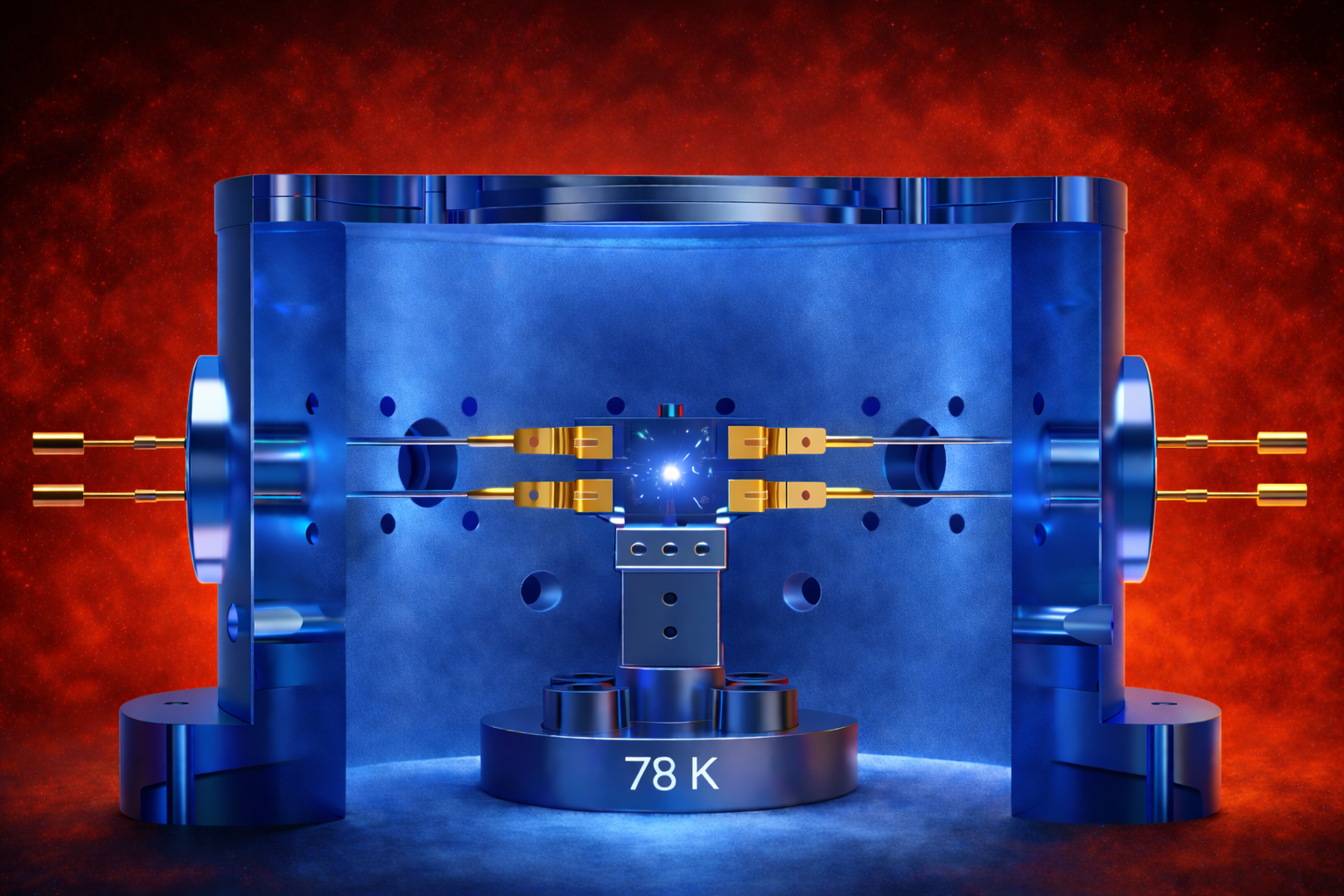
Liquid-nitrogen-cooled calcium ion optical clock
Link to the article: https://journals.aps.org/prl/abstract/10.1103/vngc-c1xv