
Recently, the in-situ biomacromolecule spectroscopy analysis team from the Innovation Academy for Precision Measurement Science and Technology (APM) has made significant progress in the research field of photochemically induced dynamic nuclear polarization (Photo-CIDNP). It has provided a new theoretical framework for elucidating the structure-activity relationship between molecular structures and polarization properties, and offered new strategies for expanding the application of Photo-CIDNP technology in complex biological systems. The relevant achievements have been published in the Journal of the American Chemical Society.
Nuclear magnetic resonance (NMR) technology plays an important role in life science and chemical research due to its non-destructive, quantitative, and structural analysis capabilities. Yet insufficient sensitivity has always been a key bottleneck. The Photo-CIDNP technology achieves dynamic nuclear polarization of target molecules through reversible photochemical reactions under mild conditions. It can significantly enhance NMR signals and shows great application potential in biological system research. However, at present, this technology still faces issues such as the limited types of polarizable substrates and the unclear structure-polarization relationship.
To overcome these challenges, the research team combined theoretical calculations with experimental verification, and discovered that the polarization performance of 19F in fluorine-containing homologues can be effectively predicted by its spin density at the corresponding free radicals. This discovery provides a theoretical basis for the efficient screening of Photo-CIDNP-responsive molecules and is expected to significantly reduce experimental screening costs. On this basis, the team designed and synthesized Photo-CIDNP-responsive and highly sensitive 19F probes targeting amine-containing compounds. Under single-sampling conditions (2 seconds), this probe can achieve rapid detection of a 1 μM amino acid mixture, with signal enhancement generally exceeding 100-fold. The detection limit for a single amino acid is as low as 20 nM (64 scans), and it has been successfully applied to the rapid detection of amine-containing compounds in cell lysates. By regulating the derivatization unit, selective detection of specific amino acids can also be achieved, demonstrating good scalability. Based on this method, the team further achieved rapid detection of the dynamic changes in amino acid content during cellular oxidative stress.
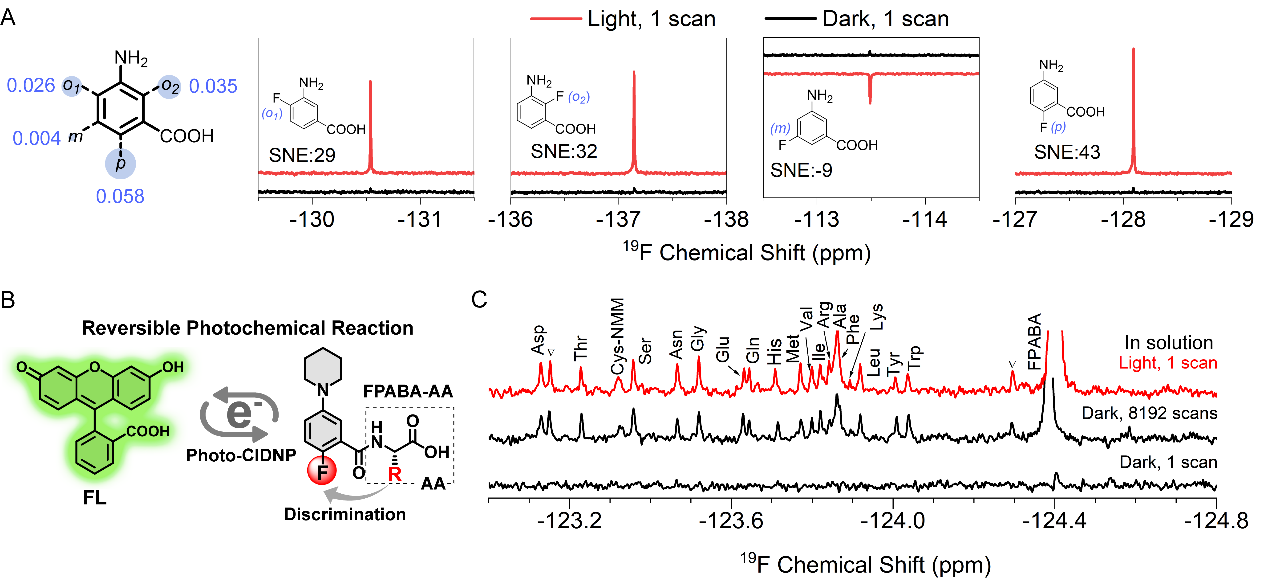
(A) The spin density and polarization performance of 19F at different positions of monofluorinated aminobenzoic acids; (B) Detection mechanism via the photo-CIDNP enhanced 19F probe.; (C) The 19F NMR spectrum of a 1 μM amino acid mixture
The relevant achievements were published in the Journal of the American Chemical Society under the title "Expanding the Molecular Scope of Photo-CIDNP for Nanomolar 19F NMR Detection of Amines". CHAI Zhaofei, an associate researcher from APM, and WANG Weixuan, a doctoral student, are the co-first authors, while researcher LI Conggang is the corresponding author.
This research was funded by projects from the Chinese Academy of Sciences, the Ministry of Science and Technology, and other institutions.
Link to the article: https://pubs.acs.org/doi/10.1021/jacs.5c21094