
Recently, the research team led by FENG Mang from the Innovation Academy for Precision Measurement Science and Technology (APM) collaborated with Zhengzhou University and other institutions, and for the first time realized the acceleration of entanglement generation in a non-Hermitian system on a trapped-ion experimental platform. This achievement successfully surpasses the traditional Hermitian quantum speed limit, boosting the preparation speed of entangled states by 1.52 times. This research achievement was published online in Physical Review Letters on May 28, 2026.
Quantum entanglement is the core resource for quantum computing, quantum communication and quantum sensing. In traditional Hermitian quantum systems, the speed of entanglement generation is fundamentally limited by the coupling strength between qubits. Whether this limit can be broken to achieve faster quantum manipulation is a cutting-edge hot issue in the current field of quantum information.
The research team introduced controllable dissipation into the ion trap system and constructed a non-Hermitian Hamiltonian with parity-time (PT) symmetry. Although dissipation effects are generally regarded as unfavorable factors that destroy quantum coherence, controllable dissipation can tune the system parameters near the exceptional point, induce geometric distortion of the Hilbert space, and thus accelerate the evolution of quantum states. The experimental results show that by utilizing this mechanism, the speed of generating the maximum entangled state is increased by 1.52 times compared with the traditional Hermitian scheme. However, the more significant the acceleration, the lower the success probability. Accordingly, the research team selected a working point that balances acceleration and success probability in the experiment. Through parity oscillation measurement, it was verified that the prepared entangled state still has high fidelity, which successfully demonstrates the practical feasibility of non-Hermitian acceleration.
This achievement experimentally confirms for the first time in a programmable quantum system that non-Hermitian systems can break the traditionally recognized quantum speed limit, and also proves that dissipation can be used as a controllable resource to accelerate quantum dynamics. This study not only provides a brand-new idea for the design of high-speed quantum gates and quantum sensors, but also opens up a new direction for the interdisciplinary research of non-Hermitian physics and quantum information science.
This study, titled “Breaking Hermitian Speed Limits for Entanglement Generation via Exceptional Points in a Trapped-Ion System”, was published in Physical Review Letters. YUAN Wenfei, a PhD candidate from APM, LIU Bingbing, a PhD candidate from Zhengzhou University, and LI Ning, a master's student from APM, are the co-first authors of the paper. Associate researcher ZHOU Fei from APM, Professor SU Shilei from Zhengzhou University, and Researcher FENG Mang from APM are the co-corresponding authors.
This research was funded by the Joint Fund Project and the General Program of the National Natural Science Foundation of China.
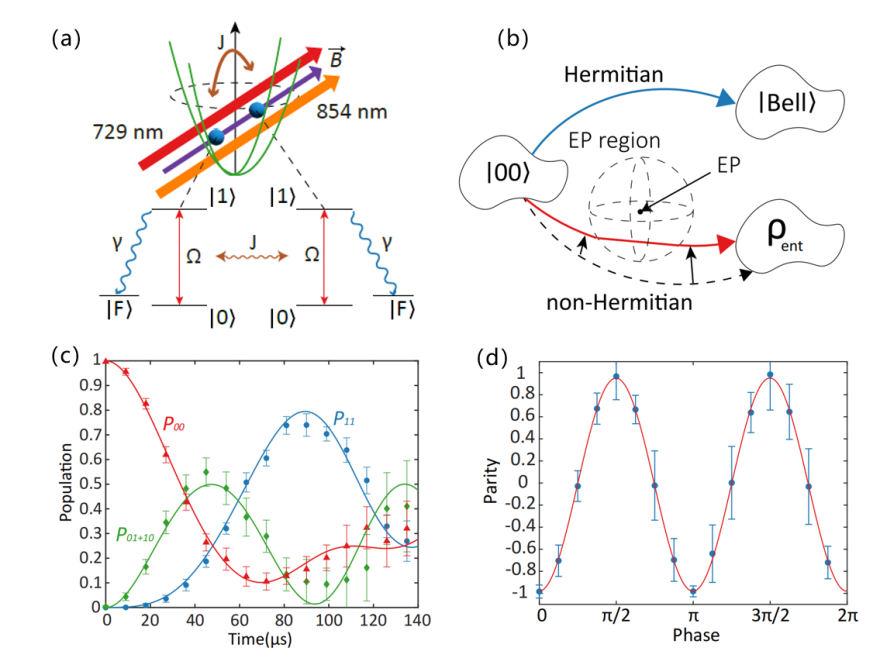
(a) Schematic diagram of the trapped-ion experimental setup; (b) Comparison of the evolution paths under Hermitian and non-Hermitian conditions, showing that the entanglement generation time is significantly shortened when approaching the exceptional point; (c) Experimentally measured evolution of the system population over time; (d) Parity measurement of the maximally entangled state generated by evolution.
Link to the article: https://journals.aps.org/prl/abstract/10.1103/g8v5-rbq7