
Recently, the Solid-State NMR and Heterogeneous Catalysis Research Team of the Innovation Academy for Precision Measurement Science and Technology (APM) has made significant breakthroughs in elucidating the reaction mechanism of zeolite-catalyzed ethanol dehydration. For the first time, the team has unveiled a "Thermodynamics-Kinetics Trade-off Effect" existing between Brønsted acid sites (BAS) and Lewis acid sites (LAS) in zeolites, which directly determines the overall reaction efficiency of the catalyst.
The catalytic conversion of alcohols (such as methanol, ethanol and higher-chain alcohols) to produce chemicals and fuels including light olefins, aromatics and gasoline is a key reaction pathway in the fields of coal chemical industry, natural gas chemical industry and biomass conversion. Zeolites play an irreplaceable role in the above processes, thanks to their tunable active sites, regular pore structure and excellent hydrothermal stability. However, the complexity of its active sites and surface species during the reaction process has long restricted the in-depth understanding of the catalytic mechanism. In particular, the structural complexity of Lewis acid sites has left their role in ethanol conversion poorly understood, which hinders the precise regulation of the functional differences between different acid sites.
In response to the above challenges, the research team adopted a method combining solid-state nuclear magnetic resonance (NMR) and density functional theory (DFT) calculations to carry out a systematic study on the catalytic behaviors of two types of acidic sites on ZSM-5 zeolite. Their experiments successfully identified three key surface intermediates governing the reaction network: the surface ethoxy species (SES-BAS) on Brønsted acid sites, the chemisorbed ethanol (CSE-LAS) on Lewis acid sites, and the triethyloxonium ion (TEO) (as shown in the figure below). Further mechanistic studies reveal a two-stage catalytic pathway with parallel dual acid sites: although Lewis acid sites can promote hydroxyl activation at relatively low temperatures (thermodynamically favorable), the subsequent β-H elimination step is significantly kinetically restricted. In contrast, Brønsted acid sites require overcoming a higher activation barrier to generate surface ethoxy species (thermodynamically less favored), but are exceptionally efficient at driving the subsequent β-H elimination to produce ethylene (kinetically favored). This intrinsic "thermodynamics-kinetics trade-off effect" constitutes the core determinant of the overall catalytic efficiency of the zeolite framework.
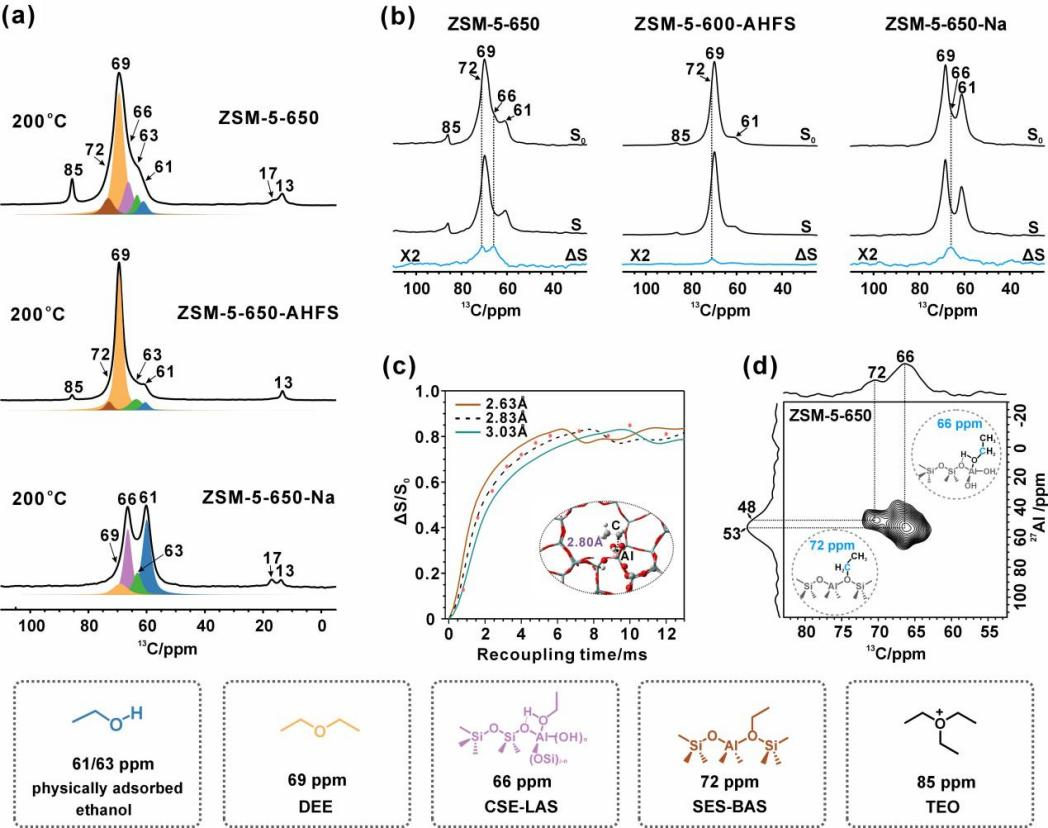
Identification of surface species during zeolite-catalyzed ethanol dehydration; (a) ¹³C MAS NMR spectra of the adsorbed species on ZSM-5 zeolite after the reaction; (b) ¹³C-{²⁷Al} S-RESPDOR NMR spectra of the adsorbed species; (c) ¹³C-{²⁷Al} S-RESPDOR experiment and simulated curves for the signal at 66 ppm; (d) 2D ¹³C-{²⁷Al} PT-D-HMQC NMR spectrum of the adsorbed species on zeolite after the reaction.
The research team also observed a consistent trade-off effect in the isopropanol dehydration reaction, demonstrating the universal applicability of this mechanism across zeolite-catalyzed alcohol transformations. This finding provides a brand-new theoretical basis for in-depth understanding and rational regulation of the dehydration reaction of alcohols on the acidic sites of zeolites.
This study, titled “Unveiling the thermodynamic-kinetic tradeoff effect on acid sites in zeolite-catalyzed alcohol dehydration“, was published in Nature Communications. HU Min, Special Research Assistant at APM, and CHU Yueying, Young Professor, are the co-first authors, while Professor WANG Chao and Professor XU Jun are the co-corresponding authors.
This research work was supported by the National Natural Science Foundation of China, the Chinese Academy of Sciences and the Hubei Provincial Department of Science and Technology.
Link to the article: https://doi.org/10.1038/s41467-026-70418-y