
Recently, the Innovation Academy for Precision Measurement Science and Technology (APM), in collaboration with Beijing Normal University and The Ohio State University, has developed two distinct schemes to characterize ice-shelf basal melting. By adopting a unified model framework and consistent climate forcing conditions, this study effectively reveals how discrepancies in ice-shelf basal melting parameterization modulate Antarctic ice sheet projection outcomes. The relevant research findings have been published in The Cryosphere.
Against the background of global warming, mass loss from the Antarctic Ice Sheet is a primary contributor to global sea level rise. Ice shelves stabilize the Antarctic Ice Sheet via their buttressing effect, however, the basal melting driven by intrusion of relatively warm waters weakens this restraining capacity, further exacerbating grounding line retreat and ice sheet destabilization. Current ice sheet models lack a unified standard for constraining sub-ice-shelf melting rates during model initialization. Different initialization schemes, including observation-driven and physical parameterization-based approaches, produce inconsistent ice sheet initial states, thereby undermining the reliability of sea level projections. Resolving such initialization uncertainties is therefore essential to improving the credibility of sea level projections.
Based on the Parallel Ice Sheet Model (PISM), the research team conducted a comparative analysis of the sub-ice-shelf melting schemes during the model spin-up process: the observation-driven scheme (S1), which adopts the ice shelf basal melting rates from satellite observations inversions, and a physical parameterization scheme (S2), built upon ocean thermodynamic parameterizations of water temperature and salinity profiles. The results show that although both schemes yield observationally consistent ice sheet geometry after initialization, they induces substantial dynamic disparities across three typical marine ice sheet regions: the Thwaites Basin in West Antarctica, Wilkes Land in East Antarctica, and George V Land–Terre Adelie (Figure 1). In the Thwaites Basin, the relatively high sub-ice-shelf melting rate in Scheme S1 gradually triggers the Marine Ice Sheet Instability (MISI), driving persistent grounding line retreat, and substantially weakening the buttressing effect of ice shelves on upstream glaciers. Compared with S2, the ice thickness simulated by S1 produces a maximum ice thickness difference of 3 meters, and an ice surface velocity discrepancy of up to 74 meters per year. In the Wilkes Land and George V Land–Terre Adelie regions, divergent ocean forcing conditions alter the thermodynamic characteristics of the grounded ice sheet and induce dynamic adjustments, resulting in approximately 6 meters of ice thickness difference and 44 meters per year of ice surface velocity difference.
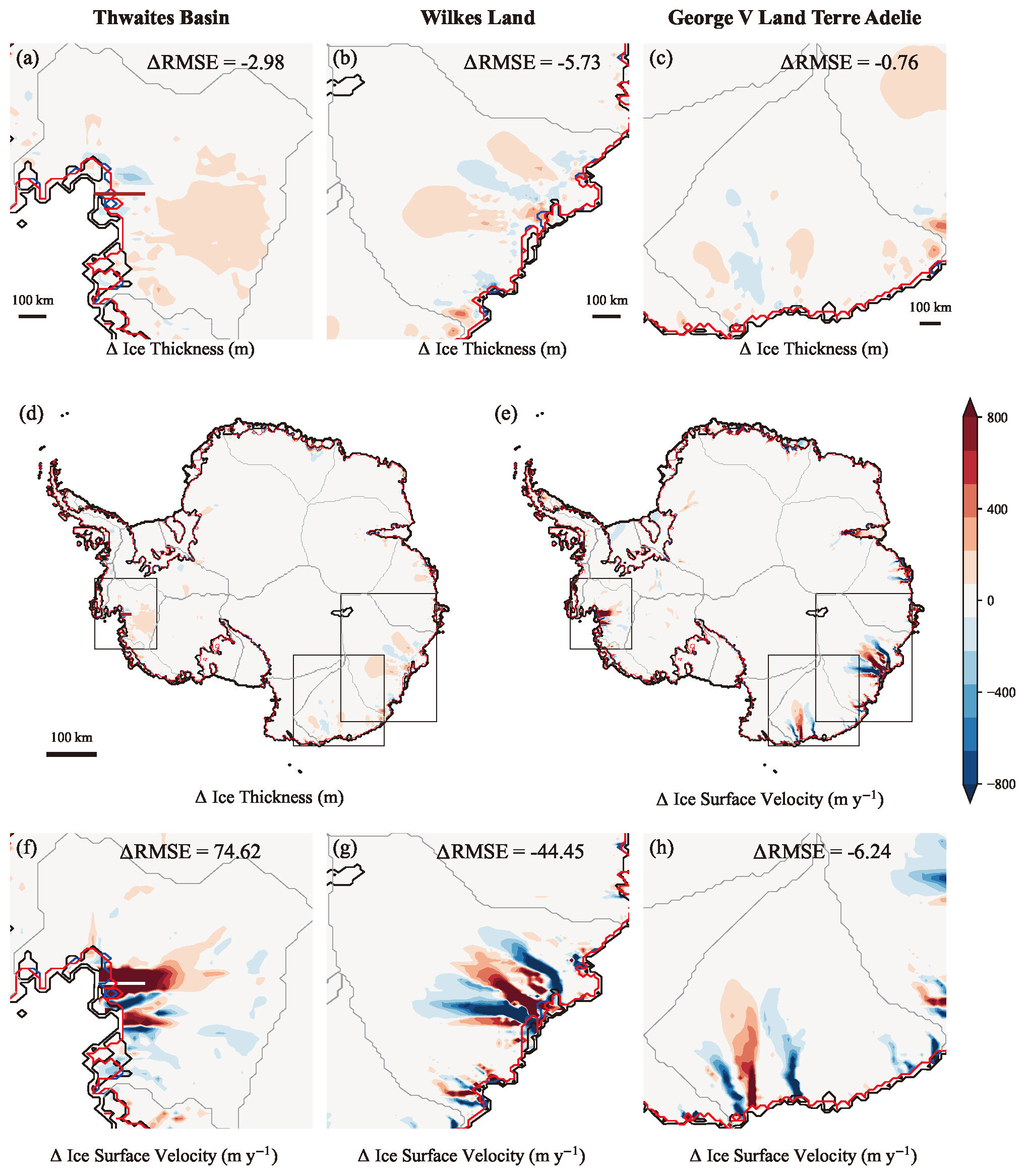
Comparison of ice thickness and velocity residuals between S1 and S2; (a-c) show the ice thickness differences in the TB, WL and GVL regions respectively, (f-h) correspond to the surface ice velocity residuals in the above three regions; (d) and (e) represent the overall deviations of ice thickness and surface velocity between the two simulation results (S1-S2); the red and blue lines denote the grounding line positions of S1 and S2 respectively, while the black line represents the observed grounding line values.
Under identical model configurations and future climate scenarios, further numerical experiments demonstrate that the Antarctic ice sheet contribution to sea level by 2100 projected by Scheme S1 is 57% higher than that of the LOW21 ensemble (incorporating S2 simulations), equivalent to a sea level rise of approximately 0.18 meters (Figure 2). This difference mainly originates from the Amundsen Sea sector in West Antarctica, a region prone to MISI development. Further analysis confirms that different sub-ice-shelf melting schemes during the initialization induce significant differences in the internal dynamic state of the ice sheet, such as basal friction and thermal structure, which are subsequently amplified via positive feedbacks and ultimately accelerate future ice mass loss.
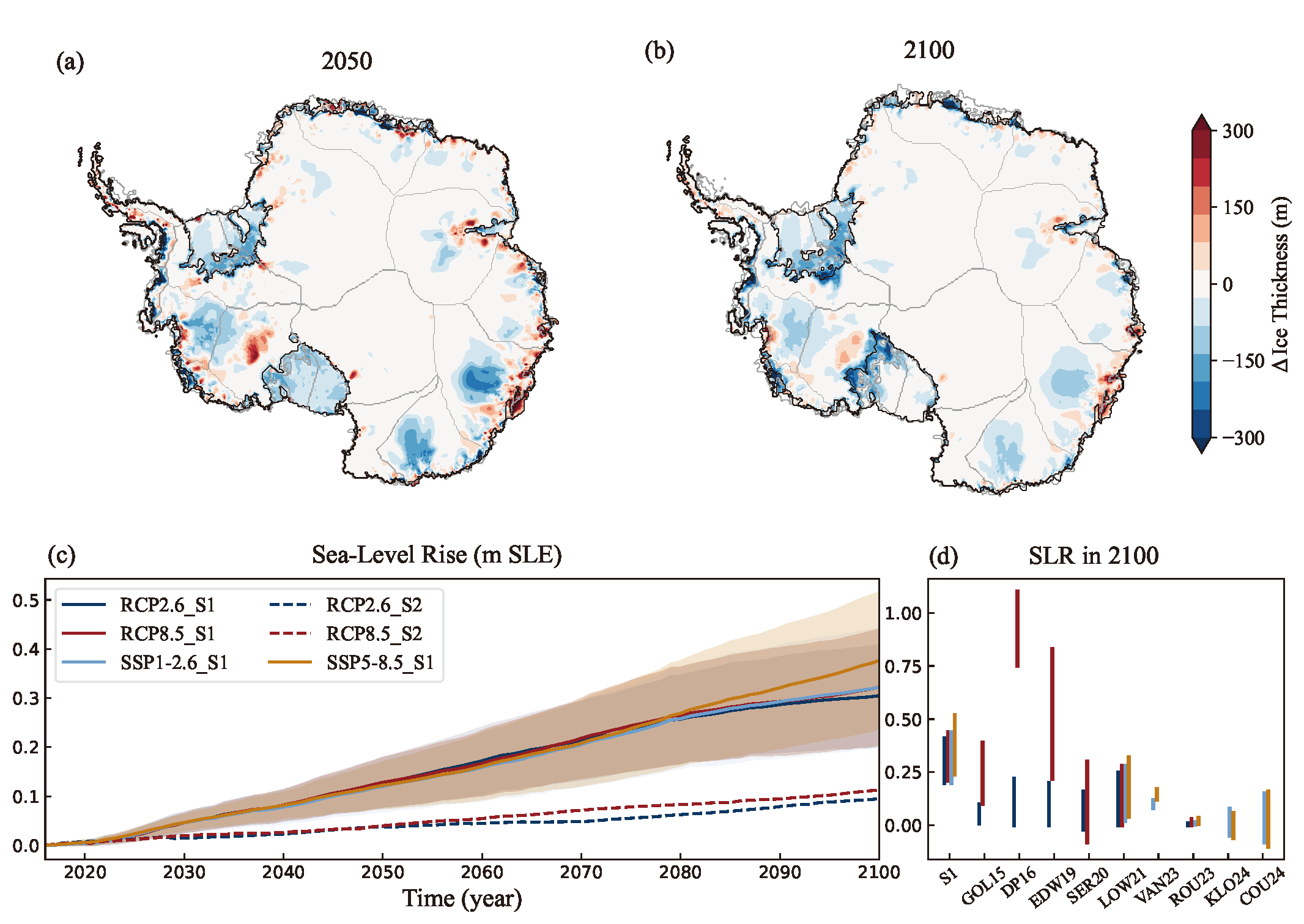
Ice sheet thickness differences and projections of the Antarctic Ice Sheet's contribution to sea level rise; (a) Mean spatial difference in ice thickness between S1 and S2 under multiple scenarios (RCP 2.6 and RCP 8.5) in 2050, (b) the same metric in 2100; (c) projected range and mean value of sea level rise under four scenarios from the "SGO scenario" to the "SGF scenario"; (d) comparison of the sea level contribution from the S1 experiment up to 2100 with results from other studies.
Amid intensifying global warming and growing concerns over the stability of the Antarctic Ice Sheet, this study demonstrates that even with similar initial geometric configurations, differences in basal melting parameterization can trigger distinct internal dynamic states and drive vastly different long-term ice sheet evolution trajectories. The findings highlight the decisive role of sub-ice-shelf basal melting processes in modulating future evolution and mass balance of the Antarctic Ice Sheet.
The relevant paper, entitled “Investigating the impact of sub-ice shelf melt on Antarctic ice sheet spin-up and projections”, has been published online. APM serves as the first-affiliation institution for this study. Researcher SHEN Qiang and Associate Professor ZHANG Tong from Beijing Normal University are the co-corresponding authors, and Ph.D. student GAO Fan from APM is the first author of the paper.
This research was supported by the National Natural Science Foundation of China and the Natural Science Foundation of Wuhan.
Link to the article: https://tc.copernicus.org/articles/20/1947/2026/